
 I was on the way home from my afternoon bike ride the other day when it looked like we would have a colorful sunset. I rode to a good vantage point near my house and captured this photo.
Pflugerville sunrise
 I have not been doing much photography lately, but I caught this stunning sunrise earlier this week while walking the dogs.
Lt. Reginald Barkley
 Barkley (we re-named him after the Star Trek character) joined our family in mid-2021. He was about 2-3 years old at the time and had lived his life before us as a badly neglected backyard breeding stud. We took care of his medical needs and showed him how a pet should be treated. He had a very good dog life as a part of our family. Unfortunately, he died suddenly and unexpectedly yesterday. He is sorely missed.
I am an athlete
 As a kid, I was not sedentary, but I never participated in any kind of sports or organized fitness activities. Nobody in my family had an interest in participating in or watching team sports, and I was never encouraged to try out team sports.
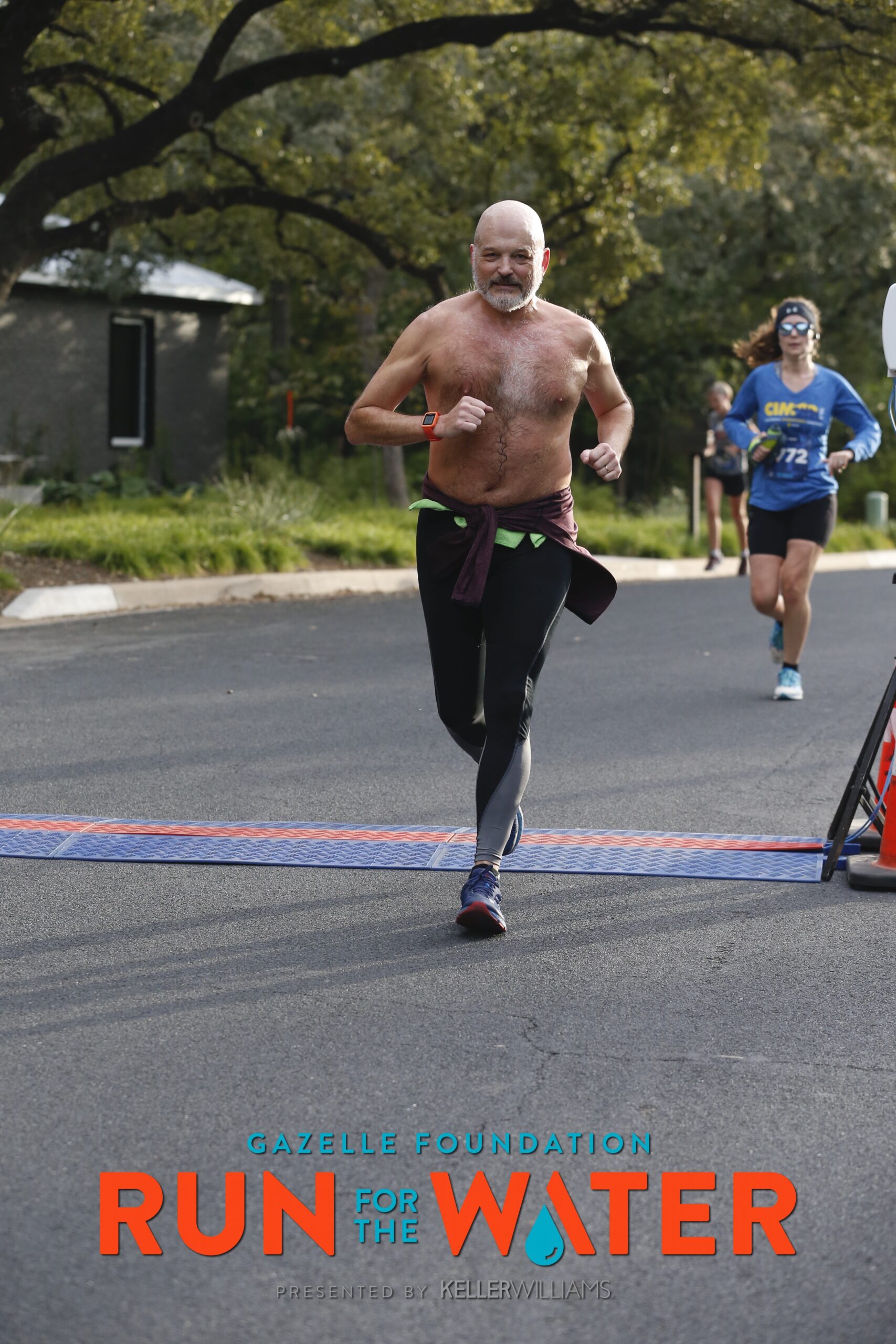
When I was a teen, I picked up jogging a little on my own initiative. When I got to college, I started running regularly and kept it up until I had to stop due to knee and foot issues1 at the end of 2019. I ran a couple of organized half-marathons along the way. At the time I stopped running, I was running 8-10 miles each, three times a week, and in 2019, I ran a total of 1,200 miles. In almost 40 years of running, I estimate that I ran a total of at least 30,000 miles. Those are not big numbers for marathoners, but it was not just casual jogging either.
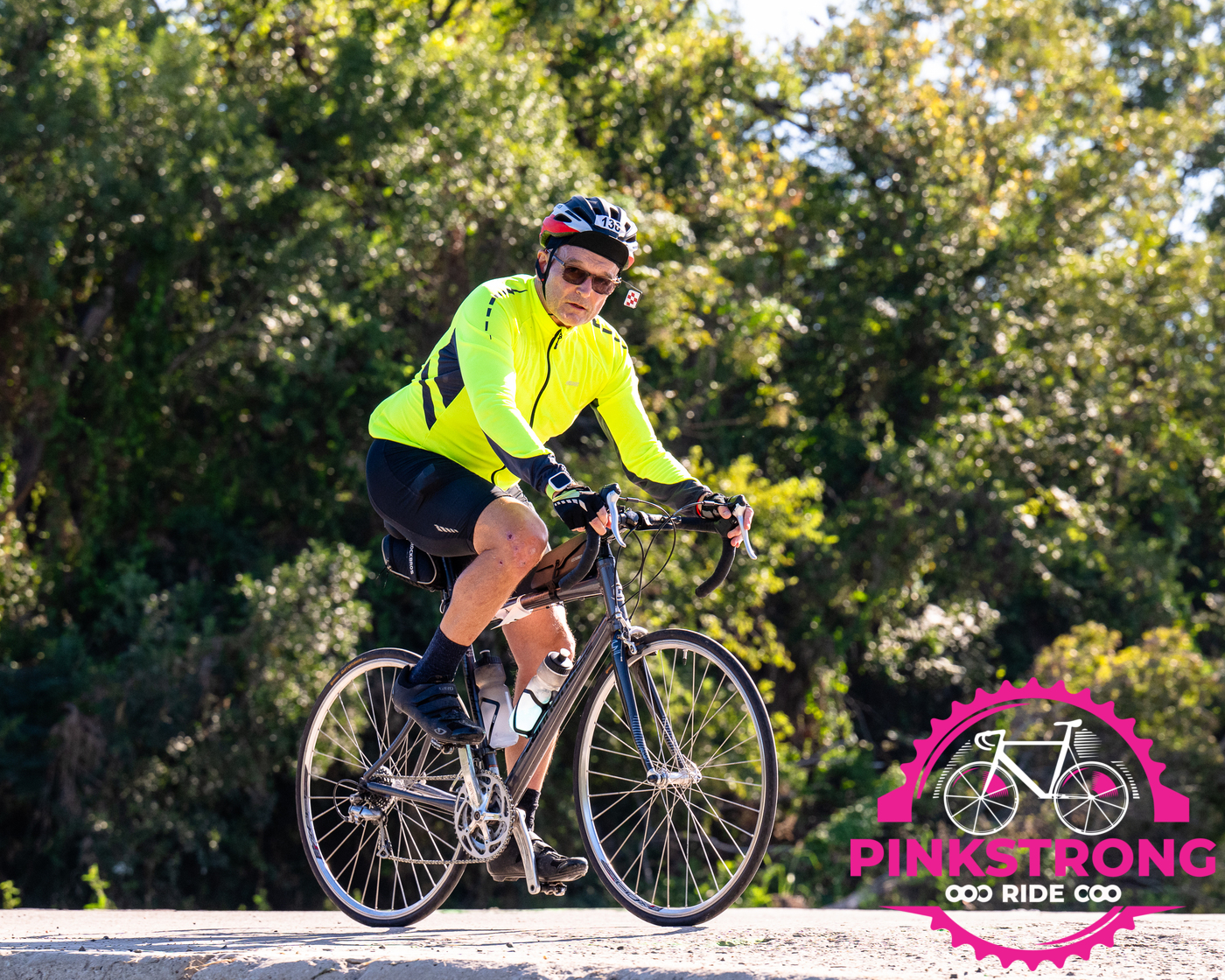
After I stopped running, I swam laps, but I never enjoyed it like I had enjoyed running. The last couple of years, I’ve picked up recreational road and gravel bicycling, and I have rediscovered joy that is similar to what I felt as a runner. I spend 8-10 hours per week on my bike and would ride more if my schedule allowed it. This year, my goal is to ride 100 miles a week or 5,000 miles total. Seven months into the year, I’m on track to meet or possibly exceed that goal. Again, like running, compared to really dedicated cyclists, those are not large numbers, but they are on the higher side for recreational cyclists.
 But I’ve never considered myself an athlete, even though the people around me have always seen me as one. A few months ago, as I was researching more about road cycling, it finally dawned on me why: I have always run and cycled just for the enjoyment of the sport. On and off, I pushed myself to longer running distances and I watch my mileage and average speed when I’m cycling, but I’ve always stopped short of actual training plans, e.g., today is my sprint day, tomorrow is my rest day, the day after that is my day for a zone 2 ride, etc. No eating plan; no measuring and obsessing over other statistics, such as heart rate zones, cycling power; no strength training in support of getting faster or covering longer distances. When I looked at people who did those things, I considered them athletes but not me.
But I now realize that I am indeed an athlete. Running was, and cycling is currently, my most important hobby. When planning my week, times to run or cycle have always been the first thing I consider. I enjoy the feeling of physically pushing myself. If I have to take a break from my sport, I feel slightly nervous. The people around me sometimes get weary of hearing about my running or cycling. It has taken some adjustment to change my attitude, but I am now comfortable with the idea that I am indeed an athlete.
The photos in this post are: running the 10-mile Run for the Water event in Austin in 2019, just before I stopped running, and riding in the 45-mile Pinkstrong ride just north of Austin, in October, 2025.
1 Before the “running ruins your knees!” crowd comes in, running didn’t mess up my knee and foot; my idiocy did. I ran with pain in my right knee and foot for almost a decade. By the time I finally got checked by the orthopedist, the cartilage in my knee was shredded and I have a bunion and hammer toe on my right foot. I will eventually need a knee replacement. The surgery to fix the hammer toe and bunion is pretty brutal, so I’ll probably just live with those the rest of my life, assuming they don’t get worse. Thankfully, these injuries stabilized when I stopped running, so I’m putting off any surgeries for as long as possible.
Reducing the cognitive load of decision-making
Years ago, I realized that people are generally expected to have opinions on things whether or not they really care about those things or have any real data to base an opinion on. Since then, I’ve tried to make it a conscious habit of thinking about whether it is worth my time and cognitive energy to form an opinion. When appropriate, I practice responding with, “I don’t have an opinion on that,” or “I don’t really have enough data to form an informed opinion,” or, if I’m being asked to choose one thing from several, “I don’t really care.” Of course, this approach works best with trivial opinions and opinions that have no real bearing on anything. There are many circumstances where it’s appropriate to educate myself enough to have an opinion, and many times, we have to make choices with little data.
This New York Times guest essay is in the same ballpark as my thinking: The Nobel-Winning Psychologist Who Believed He Found the Secret to Happiness:
If in making decisions you are often guided by a search for the best, you are going about decision making all wrong — and you’re also probably less happy for it.
In an age of information and choice abundance, we assume we can find the best of everything if we look long and hard enough. Psychologists call that tendency maximizing.
But searching for the best is the wrong goal. That is because searching is itself a cost, and most people forget to account for it. If you did, you would see that the optimal strategy isn’t optimizing at all.
There’s a better way to make decisions. To understand it, you should know about Herbert Simon, a pioneer of artificial intelligence and cognitive psychology, as well as a Nobel laureate in economics.
Mr. Simon demonstrated that for most decisions, humans can’t really evaluate the options available — there are too many, our information about them is incomplete and our minds aren’t built to weigh them all — and so we rely on mental shortcuts. He coined the term “satisficing” — a portmanteau of satisfy and suffice — to describe how we consider a limited set of options, then choose one that is good enough and move on to live our lives.
When Mr. Simon faced a decision, he considered a few alternatives, sometimes asked for advice, chose and moved on. He didn’t agonize, and he didn’t second-guess. “The best is enemy of the good” was the mantra he lived by.
Interestingly, the author touches on how the age of social media has affected this area of cognitive analysis:
This is critical today because chronic maximizing has never been easier. In 2006 an economist calculated that the consumer options available to citizens of modern economies exceeded those of preindustrial societies roughly by a factor of 100 million. That is an almost incomprehensible multiplication of choice, and it extends well beyond consumer goods into questions of who to be, how to live, where to work and whom to love.
Social media has intensified the problem by functioning as an infinite comparison engine. When you can see a curated highlight reel of everyone else’s career, relationship, home and vacation, the very concept of “good enough” begins to feel like settling.
The pull to keep searching for something better has poisoned even the most mundane moments. Research shows that giving viewers many videos to flip between makes them more bored than if they focus on just one. One way to interpret the findings is that the mere notion that something better might be out there spoils the moment.
In a similar vein, just yesterday, I came across a post on reddit aimed at older people. It showed a picture of a common clock radio from the 1980s or 1990s and asked, “Did we all have this same thing?” In a sense, we did: there were far fewer consumer choices then than now, and people had fewer ways of researching their options.
Deciphering encoded medieval manuscripts using machine learning
This is really cool: Plots, love letters and remedies: The medieval secrets being revealed by AI:
Known as the Borg cipher, the 408-page-long manuscript is mostly incomprehensible – coded using 34 obscure symbols with a few Roman letters and a front page written in Arabic. There was no known key to reveal what was encrypted. Some of the pages are also damaged due to their age, making the code even more challenging to read.
But with the help of machine learning – a form of artificial intelligence – researchers were able to unravel the code. They discovered the text was filled with thousands of bizarre treatments such as drinking several glasses of high-quality red wine or fermenting a nutmeg in some dough to combat dysentery. (You can see the full coded document online at the Vatican Library, shelfmark Borg.lat.898).
20+ years of blogging
By writing this blog post, I’m doing the very thing that I state I no longer really do…
I started this blog in 2004. Back then, sharing my thoughts with the world–or, realistically, the handful of people who actually read my blog–was a new and exciting idea. But you can see that I have rarely added new posts in recent years, and when I did, it was mostly photos I’d taken. I haven’t added many deep or shallow thoughts about the world in a long time.
The online world has changed in 20 years. We now have lots of places where we can share our thoughts with the world, and sharing your every thought, meal or other experience on social media is now the norm for a lot of people. But I’m not much of a social media user, and that change is only one small reason why I’ve not blogged much in a long time.
When I started this blog, I cared very much about my professional persona and for several years I also maintained a professional blog about software testing. I hoped that these two blogs presented a certain profile of me as a professional in my field. And if I’m honest with myself, I also cared about my overall public persona–that anyone who found my blogs, not just people in my professional sphere, would take away a certain impression of me. It’s not that I don’t care about my professional persona any longer; maintaining that image was a burden that I tired of over time, and I would hope that my work speaks for itself more now.
But here’s the biggest reason: one piece of wisdom that has become very important to over time is: in general, people just don’t think about you as much as you think they do. I’ve found this realization incredibly liberating, and I think it’s a large part of the mythos of people running out of fucks to give as they age. To reiterate what I stated above, certain people care very much about my thoughts on specific subjects, but overall, I just don’t think that my general thoughts on the world are that interesting–if anyone is even reading this blog.
Recently, I considered taking down this blog, but I enjoy reading my old posts from time to time. And I also think that it offers some interesting insights into my psyche–again, not necessarily the thoughts themselves, but at least the subjects that I chose to express my thoughts about. Again, that assumes that anyone is reading the blog. And if not, then leaving it up doesn’t matter one way or the other. But I don’t expect to be posting anything different than the past few years.
Great Blue Heron
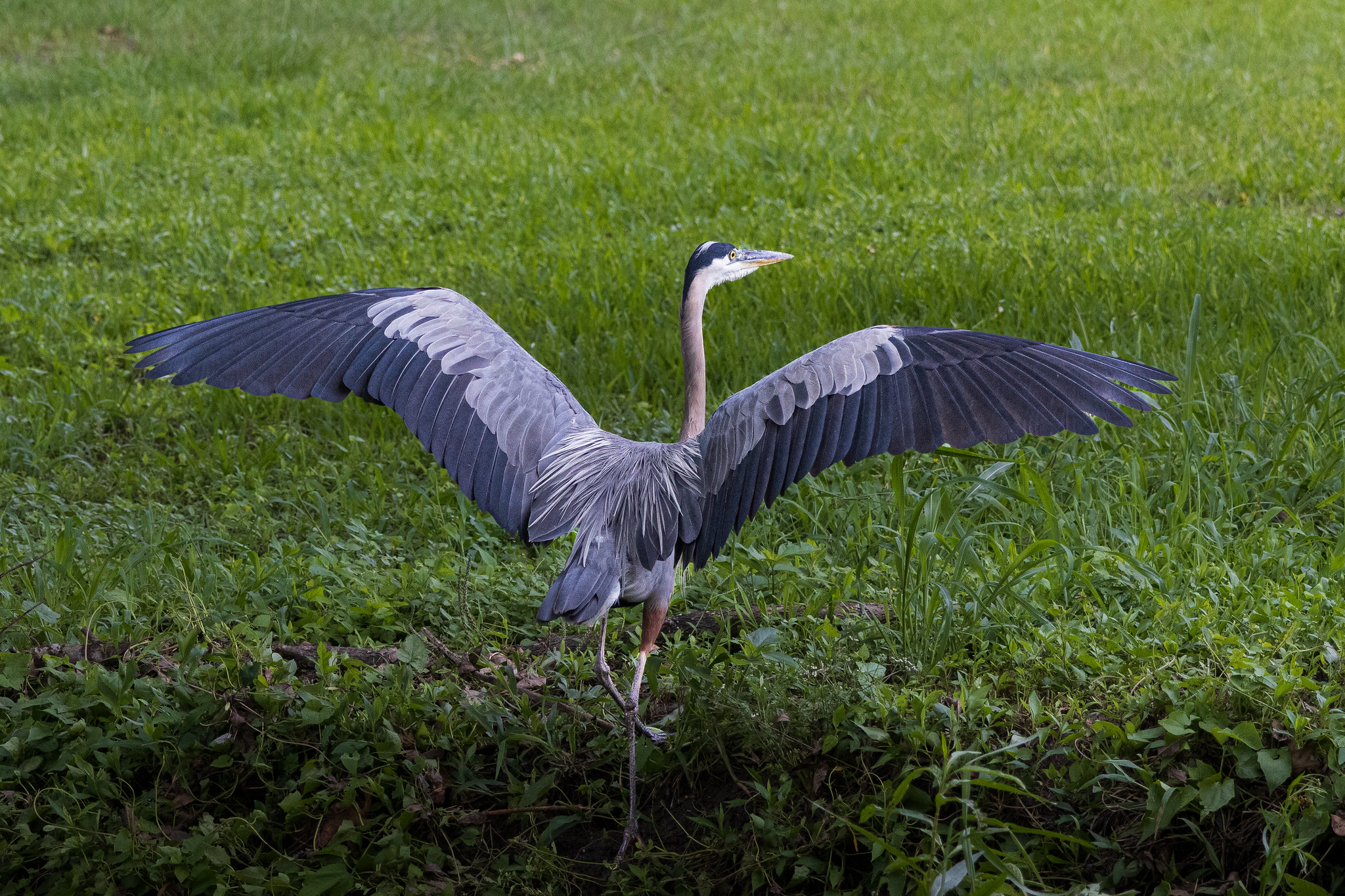
We have a small creek directly behind our house. Because this is Texas, it is dry most of the year, but at the beginning of July we had quite a bit of rain and the creek ran again for a few weeks. This great blue heron (I assume it was always the same one, who knows) spent quite a bit of time hunting right behind the house. I got some good photos of it.
Music that makes me happy: “The Bruised Reed” by Anathallo
This post is part of a series. You can read the introduction to the series here.
This is another song that perfectly demonstrates my “taste” in music: I can’t make out the lyrics very well and don’t try; it changes time signature a few times; it has an orchestral instrumentation and interesting harmonies and dissonances.
This song was first released in 2006, but I just ran across Anathallo a few months ago when someone who knows what I enjoy recommended the group to me.
Music that makes me happy “Drekovksy” by Paper Bird
This post is part of a series. You can read the introduction to the series here.
This song is a very good example of my odd focus on rhythms, riffs, less common time signatures harmonies, and less common instrumentation in music. It has it all. First off, there are no lyrics; all the vocals are just sounds. It starts off as a single melody backed by minimal instrumentation behind the voices, then it gets repeated with harmonies; other instruments and melodies are introduced until it’s a jam. Then in the middle, there is a pretty big shift in the B section, finally returning to a finale again for the A section.
Below is a Youtube video of a live performance of the song, and I enjoy that, but the album recording also features a trombone soloist which makes it better to me.
Paper Bird was released on the two-volume Carry On album. Here’s what the wikipedia page has to say about it. I’m going to have to see if I can find a video of the ballet.
In the fall of 2010, Paper Bird began working with Ballet Nouveau Colorado. The band composed the music for a ballet entitled Carry On. Their music was then combined with the choreography and films by Garrett Ammon, it thus became a multi-media performance which debuted at the Lakewood Cultural Center on February 4, 2011, and was played to sold-out houses in February. Carry On was released as a full-length, two-act live album on June 11, 2011. They recorded it live onstage with the ballerinas. Paper Bird hired Mark Anderson and Stelth Ulvang to perform the ballet. Anderson was inducted to the band’s roster after the ballet.

About Me

I am a software quality assurance engineer, father, husband, and pet lover located in suburban Austin, Texas.